Nancy Cleghorn's House
Blood ShotNancy Cleghorn’s House is a three-story home on Crandon near Seventy-third Street in South Chicago, purchased and gradually repaired by Nancy. Its old-fashioned character suggests the ordered, welcoming home she hoped to make, but after her murder the house is found ransacked: rooms, furnishings, and papers have been torn apart. The destruction turns a domestic space into a scene of intrusion and a possible search for evidence, while the surviving files point V. I. Warshawski toward a decades-old insurance connection to the Xerxes plant.
Setting and intended home
The house occupies an unusually large lot and rises three full stories. Ellen Cleghorn calls it a white elephant, a description that conveys its scale and the burden of maintaining it. Yet its appearance also explains Nancy’s attraction to it: small cupolas, stained-glass windows, and a carved wooden stair banister give the building a feeling of comfort and order. The house is not presented as a finished or effortless possession. Nancy appears to have put nearly everything she had into buying it, leaving little furniture in the front hall and undertaking repairs room by room.
The architectural details make the later damage more than a matter of disorder. This is a house with a recognizable character, assembled from features Nancy valued and spaces she was working to restore. Its old-fashioned charm sits alongside practical signs of incompletion: an unfinished study, an old kitchen, and rooms that have received different levels of repair. The contrast between the house’s promise and its condition makes the destruction legible as an assault on both Nancy’s work and the home she was trying to establish.
Renovation and everyday use
Nancy had made the main bedroom her first major renovation project. Its floor had been finished, its walls plastered and painted, and a working fireplace installed opposite the bed, with a tiled mantel and brass fittings. The room’s careful improvements mark the house as an ongoing project rather than a static backdrop. Her work had created a settled, appealing room, but its furnishings and bedding are later thrown about by the intruders.
The dining room was the only other space Nancy had substantially repaired. She used its built-in cupboards as a small home office while waiting until she had the time and money to renovate the study. The cupboards therefore held more than household possessions: they served as part of her working life, and the papers kept in them recorded aspects of her personal and financial affairs. Her plans to complete the study and the evidence of limited resources place the house’s unfinished spaces within the practical constraints of buying and improving it.
The kitchen had fared worse even before the intrusion. Its fixtures dated from the 1920s; the sink and icebox were old, and the walls were peeling. The house contained six fireplaces, a detail that later acquires a different significance when their grates are found missing. Together, these rooms show a home being repaired selectively, according to Nancy’s means and priorities, rather than renovated all at once.
The ransacking
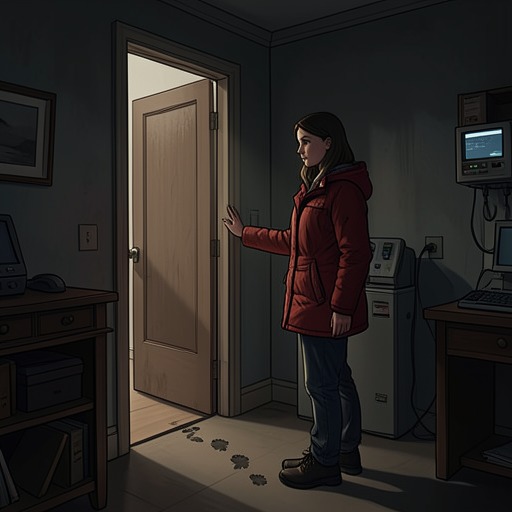
Ellen discovers the damage when she goes to Nancy’s house to collect financial records. The initial signs are not obvious from the bare front hallway; the destruction becomes apparent when V. I. Warshawski reaches the main bedroom. The furniture and bedding have been thrown around, and the bedroom is only the beginning. In the dining room, plates and tableware lie on the floor, chair seats have been ripped away, and every shelf in the walnut cupboards has been splintered. Nancy’s papers are scattered across the room, converting the place where she kept her office into a wrecked archive of her private life.
The search appears deliberate and extensive. The intruders have torn open the mattress and cut through its stuffing, lifted the fireplace grate, and removed bricks. In other rooms, loose floorboards have been pried up; grates are missing from all six fireplaces. The kitchen has also been searched, with flour and sugar dumped on the floor and food pulled from the refrigerator. These details leave the object of the search uncertain. Warshawski considers whether the intruders wanted money, but also whether they were looking for papers or evidence connected to something dangerous enough to provoke a killing. The house itself does not establish what they sought or who entered it.
Warshawski recognizes the destruction as a personal violation: if a person cannot feel secure at home, the damage reaches beyond the rooms themselves. Her response is practical as well as emotional. She moves through the house despite knowing that she is disturbing possible evidence and has not reported the damage to the police. In the dining room, she and Ellen recover bank statements, an address book, and papers concerning the mortgage or insurance for Ellen to review. The recovery is partial; the searched and scattered papers make it difficult to tell what may be missing.
Papers and investigative significance
Nancy’s sky-blue Honda, parked outside the house, provides a separate cache of material. Ellen explains that a South Chicago Revitalization Project (SCRAP) worker brought the car to her after the funeral; she had a spare set of keys. Warshawski takes the briefcase and the additional files from the back seat, agreeing to return Nancy’s work papers to SCRAP. The files are not found in the rooms, so the car’s contents should be distinguished from the papers strewn through the house. Together, however, the house and car show how Nancy’s working records and personal documents have become central to the inquiry.
Among the files, Warshawski finds a photocopy of a 1963 letter to Mariners Rest Life Assurance Company. It states that Jurshak & Parma had become fiduciaries for Humboldt Chemical’s Xerxes plant. An attached actuarial study compares Xerxes’s losses with those of similar companies in the area and requests comparable rate consideration. At first the document seems ordinary, unrelated to Nancy’s environmental work, and too old to explain why anyone might have killed her. Its presence among her papers nevertheless gives Warshawski a concrete lead: an insurance relationship linking Art Jurshak’s firm and Humboldt Chemical’s plant. The house’s importance thus lies not only in the violence done to a home, but in the questions left among the documents that survive the search.